Patient Education
We've created this page to provide you with some useful information regarding certain topics that come up time and time again.
Use the links below to direct you to a specific topic and remember that any questions you may have can always be directed to my incredibly capable staff or myself via email or phone.
Points of discussion are:
Blepharitis
TopBlepharitis is a chronic inflammation of the eyelids which causes irritation, itching, and occasionally a red eye. Blepharitis can begin in early childhood producing "granulated eyelids," continue through life as a chronic condition or it may develop in later life. There may be a loss of eyelashes and distortion to the margins of the eyelids, which can cause chronic tearing. It may appear in one of two ways.
SEBORRHEIC BLEPHARITIS is characterized by redness of the lids, scales and flaking around the eyelashes. It is often associated with dandruff of the scalp.
ULCERATIVE BLEPHARITIS is a more severe condition cased by bacteria and is characterized by matted hard crusts around the eyelashes which upon removal leave small ulcers that may bleed or ooze. The white part of the eye may turn red. In severe cases, the cornea (the clear front window of the eye) may become inflamed.
HOW IS BLEPHARITIS TREATED?
In view of the longterm nature of the condition, strict eyelid hygiene is necessary. We recommend baby shampoo (less tearing) lid scrubs followed by hot compresses on a daily basis until the irritation is relieved. After comfort is achieved, maintenance lid scrubs on a less frequent basis is necessary to prevent recurrent irritation. Treatment of oily scalp with anti-dandruff shampoos (Selsun Blue™) may also be helpful.
The following regimen may be useful:
- Fill a drinking glass with warm water.
- Add one capful of baby shampoo.
- Soak a clean cotton ball (or Q-tips) in the solution.
- Gently scrub the eyelashes of all 4 eyelids.
- Rinse with warm tap water and dry with a clean towel.
- Place a warm compress against the eyelid for 15 minutes.
- Use medications as directed.
In more severe cases, various antibiotics and even cortisone preparations may be necessary to alleviate the condition. Once the acute phase is controlled, lid hygiene, as described above, and the use of bland ointments may be sufficient to maintain control of blepharitis.
If your eyelid irritation persists or progresses, please return for a followup examination. If you have any questions or concerns, please do no hesitate to contact our office!
Dry Eyes
TopDry eyes can be a very uncomfortable condition which may be temporary or long term. Dry eyes can cause pain, visual blurring, burning, foreign body sensation, irritation, light sensitivity and redness The discomfort is related to the breakdown of the ocular surface and varies from mild to severe.
The cause of dry eyes may be due to environmental factors (low humidity, wind/fans, air conditioning, contact lenses,) related to medical conditions (Sjogrens' syndrome, drugs, pemphigoid, vitamin A deficiency) or from anatomic dysfunction (incomplete blink, eyelid scarring, paralysis abnormal tear film.)
The drugs which aggravate dry eyes include the following: Weight loss products (Dexatirm, Accutrim) Cough preparations (Benylin cough Syrup, Triaminic DM Liquid, Novahistine DMX Syrup) cold Preparations (Dimetapp Elixir, Alka-Seltzer Plus Cold, Contac Cold formulas, Antihpyertensives (Minipress, Catapres) Diuretics (Lasix, Bumex, Diuril) Antipsychotics (Mellaril, Thorazine) Antiparkinson Agents (Cognetin, Artane), Sedatives (Dalmane, Valium, Halcion), Caffeine and Nicotine.
TREATMENT
Dry eyes are frequently a chronic disorder that can be controlled but rarely "cured." Dry eyes can be associated with dry mouth and arthritis, known as Sjogrens syndrome. There are five levels of treatment for dry eyes; environmental factors, lubricants, punctal occlusion, medications, and surgery.
Environmental Factors for Dry Eyes
There are many issues associated with your local environment that can make dry eyes worse. For example; smoking, air conditioning, dust, air pollutants, allergens, ceiling fans or car vents can create dry eye issues even among people without an underlying dry eye problem. Many times these situations can be improved with simple avoidance, home or room humidifiers, and barriers like contact lenses, sunglasses, or wind protective goggles; such as those used by the military in Iraq, or for motorcycle riding: See WileyX.com
Lubricants for Dry Eyes
Artificial tears are the mainstay for treating dry eyes. There are many different brands of artificial tears that may be purchased over the counter. Artificial tears frequently have the name "Tears," such as, Tears Plus, Tears Naturale, Hypotears...etc. In addition, thicker artificial tear ointments or salves are available (Lacrilube, Refresh PM, Duolube).
The natural tear film has three layers; an oily top layer, a watery middle layer, and a mucous deep layer. It may help to try artificial tears from each category designed to replace individual tear layers to discover which one works best for you.
- Oily layer tears: Bion tears, Soothe, Refresh Endura
- Watery layer tears: Hypotears, Refresh, Genteal
- Mucous layer tears: Celluvisc, Systane, Ultratears
The goal in treating dry eyes is to keep your eyes comfortable all of the time. The biggest mistake is failure to use the drops enough.
You may require using drops frequently (up to every hour during the day) to keep your eyes comfortable. If hourly drops become a burden or are unsuccessful, you should use ointment. The ointment last much longer but blurs your vision. Therefore, you can either use ointment at bedtime, or you can use ointment during the day by alternating eyes. In this manner, you will have one eye for vision and the other eye protected with ointment. A simple way to gauge how much ointment you are using is to place a ribbon of ointment on a Q-tip before rolling it in between the lower eyelid and eyeball. In this manner, you will know exactly how much you put in and be able adjust this amount depending upon your response. For example, if you place too much ointment in your eye, you may wake up with blurry vision. In that case use a little less the next night.
If you require frequent use of artificial tears and ointment (more than four times per day) we recommend that you use preservative free preparations (Celluvisc, Refresh PM, Hypotears ointment...etc.) This will prevent the development of allergic reactions to the preservatives.
***IF YOU CONTINUE TO HAVE DISCOMFORT, REDNESS OR IRRITATION IN SPITE OF ARTIFICIAL TEARS, CONSULT YOUR DOCTOR IMMEDIATELY!!!***
Punctal Occlusion for Dry Eyes
When lubricants are not enough, you can increase the available tears in your eyes with punctal occlusion. When you place a stopper in a sink it keeps water in the sink, and punctal occlusion works the same way. Plugs allow you to keep your natural tears and any artificial tears in your eye longer.
There are two tear ducts that drain tears away from your eye located along the nasal upper and lower eyelids. There are various methods to occlude the tear ducts, both temporary and permanent. It is best to begin with temporary or reversible methods to determine your needs; i.e. occlusion of the lowers, uppers or all four puncta. When necessary, the tear ducts can be permanently occluded with minor surgery, usually done in the office. While surgery can reverse permanent punctal occlusion, it is better to be sure you do not develop spillover tearing with temporary occlusion before you commit to permanent occlusion.
Medications for Dry Eyes
Restasis ® is an anti-inflammatory medication (cyclosporine) that can help produce a better quality of tears in patients with chronic dry eyes. Restasis® can reduce the inflammation of the ocular surface that may interfere with producing a normal tear layer. It is typically used twice daily and may take up to two months for the full effect to become apparent.
Topical steroids may be necessary for more significant inflammations causing dry eye symptoms. However, steroids are best used for short-term control of ocular surface inflammation and should be closely monitored by an ophthalmologist to avoid complications like glaucoma, cataract, or infections.
Mucolytic drops can be custom formulated to decrease the thickness of tears when excess mucous production is an issue.
Serum tears can be custom formulated from components within your own blood which have been found to be helpful to stabilize the surface of the eye in cases of severe dry eye. Serum tears are custom blended by a pharmacy using your own blood serum mixed with artificial tears.
Omega-3 fatty acid dietary supplements have been reported as helpful in treating dry eyes, but their use has not been fully studied.
Antibiotics may be helpful to treat local eyelid infections that can make dry eye symptoms worse.
Surgery for Dry Eyes
When necessary, surgery can be performed to improve eyelid function and reduce the exposure of the eyeball. Surgery can improve the quality of the ocular surface by improving each blink, maximizing eyelid efficiency moving the tears across the eyeball, accelerating tear drainage, and allowing the available tears to work on a smaller area. The type of surgery may include raising the lower eyelid, lowering the upper eyelid or making the eyelid fissure smaller by narrowing the inside and outside corners. In selected cases, the lining of the ocular surface may be improved by grafting stem cells from the opposite eye for unilateral dry eye problems, and grafting amniotic membrane, or from the mouth for more extensive and bilateral dry eye issues.

How Much Swelling and Bruising?
TopAs a natural reaction to tissue injury your body may swell and bruise. In the long run, swelling and bruising is of no significant consequence. However, in the short term, you will be able to see better and return to normal function sooner with less swelling and bruising. I can control most of the issues that cause bruising, but there are two things that cannot be controlled; the last stitch passed to close your wound and the relaxation of blood vessels after the anesthetic wears off.
The amount of reaction you experience depends upon a variety of factors. You can reduce the swelling and bruising dramatically by following some simple steps. First, do not take any aspirin or aspirin products at least ten to fourteen days prior to your surgery (see aspirin list) (in pt education area). Next, use cool or ice compresses as much as possible in the first three days following your surgery, particularly in the first day. Finally, by the third day, whatever amount of swelling and bruising you have will not go away with cool compresses. At this point, warm compresses will help promote healing by increasing the blood supply to the tissues. If you experience any excess swelling after beginning warm compresses, you may alternate warm and cool compresses.
Some patients feel the herbal Arnica Montana is helpful in preventing bruising or swelling. I have no strong feelings regarding this product, but those that use it are typically more compliant with all of our instructions, tend to live healthy lifestyles, and experience better than average results.
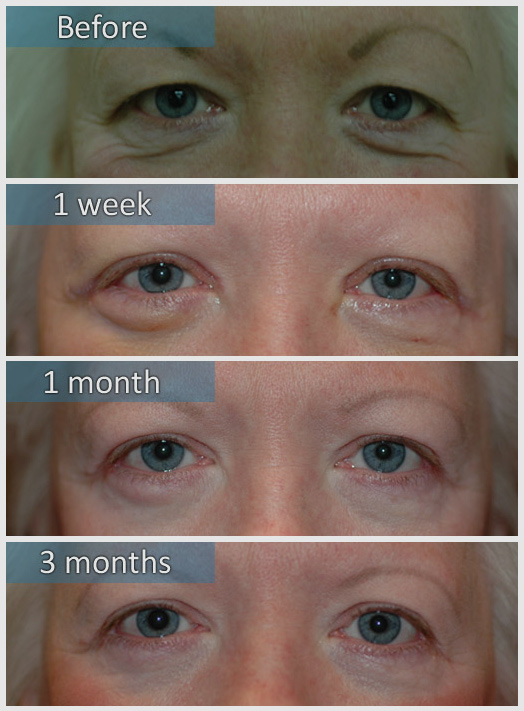
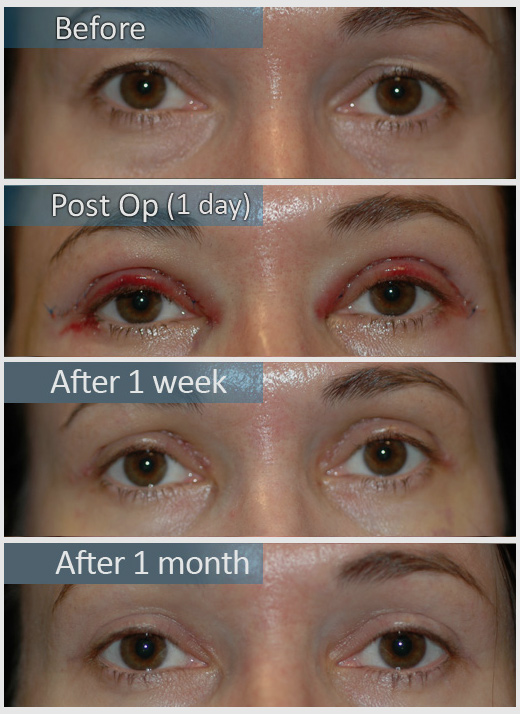
The photo series on the left demonstrates the amount of swelling after a four eyelid blepharoplasty. The photo series on the right demonstrates the amount of swelling after a two eyelid upper blepharoplasty. Please note that these photos represent outstanding results with very little postoperative swelling due to their compliance and a little good luck. Your results may vary.
Protecting your skin from the sun
TopExcessive exposure to sunlight damages the skin and is an important factor in the development of skin cancers and accelerating aging changes. Ultraviolet rays are especially damaging. The following suggestions are beneficial in protecting your skin from the sun.
-
Clothing:
Protective clothing, such as long-sleeved shirts and wide-brimmed hats, should be worn to protect the skin. -
Activity:
Sun bathing should be avoided. Sports and recreation involving sun exposure should be done early in the morning or late in the evening to decrease sun exposure. -
Ultraviolet Screening Sunglasses:
Regular sunglasses decrease the intensity of sunlight. However, the damaging ultraviolet rays cannot be seen and may still penetrate regular sunglasses. UV light may be an important factor in the development of skin cancer of the eyelids, growths on the eyeball, and possibly cataract. There are special lenses that filter out the ultraviolet rays to protect your eyes and eyelids. There are many different brand names for these lenses (UV-400, Revo, Bolle, etc.) and you should ask if the sunglasses you are considering filter out the ultraviolet light. These UV protective lenses are available in any shade, tint or may even remain as clear glass. Ask your optician. -
Sunscreens:
Sunscreens and suntan lotions are extremely important. They are rated on a sun protection factor. This is noted on the container as SPF. A sun protection factor of 15 (SPF-15) would mean that use of this agent would expose your skin to the same amount of UV light rays after 15 hours that you would have otherwise received after 1 hour without it. In Arizona, we recommend using a sun protection factor of at least 15. There are sunscreens with SPF over 30. Clinique and Estee Lauder are two products with high sun protective factor ratings. A #15 sunscreen lip balm is available that can be easily applied to the lips as well as the lower eyelids to offer protection in these vulnerable areas. Remember that sunscreens should be reapplied frequently to maintain their protective effect. -
Tanning Booths:
The AMA Council on Scientific Affairs has reported the widespread use of fluorescent sunlamps, and tanning booths are potentially dangerous and constitutes a health hazard. The ultraviolet light used (UV-A) penetrates deep into skin and may cause premature aging by modifying fibers that maintain the skins normal resiliency. In addition, both short and longterm exposure to high intensity UV-A radiation may cause disturbances in the immune system, skin cancer, cataracts, or possible retinal damage. The best protection according to the report is to avoid cosmetic tanning altogether including tanning with natural sunlight.
If you have any suspicious skin lumps or sores that do not heal, the area should be evaluated by a physician interested in skin cancer.
CORTICOSTEROID INFORMATION
TopCorticosteroids are powerful medicines used to treat a variety of inflammatory disorders to prevent or reduce damage to your body. In ophthalmology, steroids are used to preserve vision by suppressing inflammation that destroys or interferes with the normal structure and function of the eye and its surrounding tissues.
Steroids are normally produced by your body daily, but are used in much greater doses for medical purposes. The effects of steroids at high doses are powerful and beneficial. However, common side effects include the following: weight gain, fluid retention, elevated blood pressure/sugar, weakening of bones, stomach ulcers, nervousness and suppression of your immune system.
Therefore, you will require careful monitoring while you are being treated with steroids, particularly if you have a chronic infection (ie. TB), hypertension, peptic ulcer or gastritis, diabetes, cardiovascular disease, osteoporosis or psychologic disturbances.
Important DO'S and DON'TS while on therapeutic corticosteroids:
DO's:
- Follow directions carefully.
- Take steroids with meals or snacks.
- Always take steroids in the morning if only one dose.
- For multiple doses, take them at evenly spaced intervals.
- Eat meat, bananas, raisins or juices rich in potassium.
- Antacids, mild or non-spicy foods, or a high-calcium diet are helpful
- Minimal salt intake, or use a potassium chloride salt.
- Exercise regularly.
DON'Ts
- Do not stop taking steroids suddenly, they must be tapered.
- Do not get vaccinated, especially against smallpox.
- Avoid contact with patients with colds, flu or infections.
- Avoid sweets, starches and salty foods
When you become ill or need an operation, your body normally increases its steroid output 5-15 times the normal amount. While on oral steroids, your body may not be able to produce the amount you need in such emergencies. Therefore, it is important to see your physician on a regular basis to regulate your steroid dose for the appropriate circumstances.
NOTIFY YOUR DOCTOR FOR THE FOLLOWING:
Before taking new medications, before modifying the current dose of steroids, visual change, eye pain, weight gain, swelling, muscle weakness, black tarry stools, vomiting of blood, infection, burning, pulling of the face, menstrual irregularities, prolonged sore throat, fever, cold, fatigue, depression, change in appetite, nausea, dizziness, nervousness or change in sleep patterns.
TopNUTRITION: a collection of guidelines to maximize your health
TopIt is universally accepted that proper nutrition is a key to good health, a sense of well being, and maximizing your physical/mental performance. In addition, thoughtful food choices may help prevent disease, allow you to heal faster after surgery, and maintain a normal weight. While many people regularly take vitamins, read food labels, and shop for natural products, a healthy lifestyle depends upon your daily choices regarding the quality of your calorie intake and how it balances with your physical activity.
There is an enormous amount of information available regarding healthy nutrition. I’ve learned quite a bit in collecting these links. I sincerely hope you enjoy exploring these resources and use the information to assist your daily nutritional choices.
General Nutrition Information
- Nutrition.gov: Smart Nutrition 101
- The CalorieKing.com Food Database
- MedlinePlus: Nutrition for Seniors
- Center for Disease Control and Prevention: Nutrition Introduction/a>
- USDA Center for Nutrition Policy and Promotion
- The Food and Nutrition Information Center
- American Dietetic Association: Eat Right
- American Dietetic Association: Nutrition Fact Sheets
- Mayo Clinic: Food and Nutrition Center
- MedicineNet.com: Seven Diet Sins and common nutrition mistakes
Kids Nutrition
Nutrition for Specific Diseases
- American Diabetes Association: Nutrition & Recipes
- Nutrition: NIDDK
- Nutrition in Cancer Care
- American Heart Association: Diet and Nutrition
Sports Nutrition
Vegetarian Lifestyle
Smoking
TopAttention Smokers: this is a place to assist you in controlling the urge to light up. The health effects of smoking have been well established and popularized by the following messages on cigarette packages:
- SURGEON GENERAL’S WARNING: Smoking Causes Lung Cancer, Heart Disease, Emphysema, and May Complicate Pregnancy.
- SURGEON GENERAL’S WARNING: Quitting Smoking Now Greatly Reduces Serious Risks to Your Health.
- SURGEON GENERAL’S WARNING: Smoking by Pregnant Women May Result in Fetal Injury, Premature Birth, and Low Birth Weight.
- SURGEON GENERAL’S WARNING: Cigarette Smoke Contains Carbon Monoxide.
It is the last warning that has the greatest effect for cosmetic patients. Since carbon monoxide binds to red blood cells tighter than oxygen, it reduces your body’s ability to deliver oxygen to the tissues. The effect is to prematurely age your skin, slow the healing process, and decrease the quality of your surgical result.
In order to quit smoking you are faced with overcoming both a personal habit and a physical addiction to nicotine. In most cases, this is no small task and requires a strong commitment to stop. My mother quit smoking decades ago, but she still reports that the urge to smoke occurs on a daily basis. Brandy, one of my office secretaries, found the motivation to quit smoking after attending the "BodyWorlds" international exhibit that included lung specimens of smokers compared to non-smokers.
If you choose to stop smoking, understand that we are here to assist and support you with your goal. I wish you the best and hope you find the following links helpful.
- American Lung Association | Quit Smoking Action Plan
- Center for Disease Control and Preventions page on quiting smoking
- American Cancer Society's Quitting Smoking Guide
- WebMDs guide to smoking cessation
- Stop Smoking | Online Support community
- The Foundation for a Smokefree America
- Smoking and Thyroid Disease